Practical answer
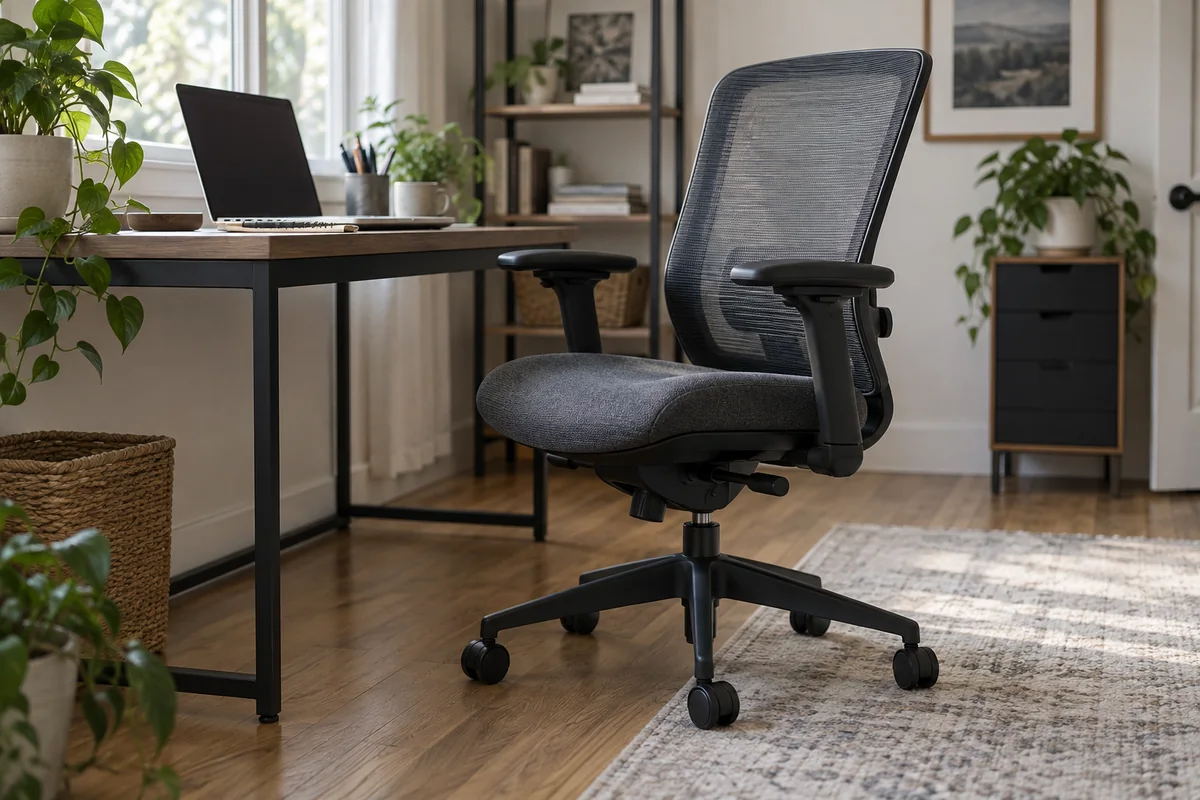
The best small-space office chair is not necessarily the narrowest model. It must fit the user, roll into the real floor area, let the arms clear the desk, and still provide usable seat-height and seat-depth adjustment.
Measure the chair in two states: the working position and the parked position under the desk. Then compare published overall width and depth with seat dimensions, arm range, caster behavior and return terms.
- Measure the desk opening and floor turning area
- Separate outer size from seat fit
- Check arm-to-desk clearance
- Use a return window to validate personal comfort
Measure the room as a movement envelope
- Measure clear width and height beneath the desk, including drawers, frame rails and cable trays.
- Mark the normal keyboard position and the chair centerline. Measure the floor depth needed to sit, recline modestly and stand up.
- Check nearby walls, bed frames, cabinets and doors across the caster path, not just the chair footprint in a product image.
- Record the users seat-height need, comfortable seat depth, hip clearance and desired arm position.
- Compare both overall dimensions and adjustment ranges. Reject any chair that fits the room but not the person.
Dimensions that solve different problems
| Published dimension | What it tells you | What it does not tell you |
|---|---|---|
| Overall width | Whether the chair can pass obstacles or park in an opening | Usable width between the arms |
| Overall depth | Approximate parked and turning footprint | The floor space needed while reclining |
| Seat depth range | Whether thighs can be supported without pressure behind the knees | Personal comfort of the seat shape |
| Seat-height range | Whether feet and input height can be coordinated | Whether the desk itself is low enough |
| Arm height and width | Potential keyboard support and desk collision | Whether a specific arm shape clears the apron |
Fit takes priority over a compact silhouette
OSHA recommends trying chairs because adjustability does not guarantee a match for every body. The backrest should support the lower back, the seat should support the thighs without pressing behind the knees, and the feet should rest on the floor or a stable footrest.
In a tight room, removable or highly adjustable arms can be more useful than shaving an inch from the base. If armrests stop the chair approaching the keyboard, the user may reach forward and lose back support.
Treat configuration and return terms as part of fit
- Confirm which seat-depth, lumbar and arm adjustments are included in the exact configuration rather than shown as optional.
- Match caster type to the floor and include any protective mat in the movement test.
- Check assembly and return conditions before discarding packaging; a chair can fit the room and still fail the personal comfort trial.
- Do not pay for decorative upgrades until the functional adjustment ranges and desk clearance are confirmed.
Published-spec examples for different constraints
These examples are not universal rankings. Each one remains on the shortlist because its published design fits a different workspace constraint. No affiliate relationship influenced inclusion.
| Model | Useful for | Published highlights | Verify before buying |
|---|---|---|---|
| Series 1 Chair Steelcase | Small offices where chair width must be measured | Published 23.5-27-inch overall width; 15.5-17.75-inch functional seat depth | Configuration changes the final width and fit |
| Sayl Chair Herman Miller | Rooms where visual bulk matters as well as floor area | Published 24.5-inch width and 19.75-inch depth; 16-20.5-inch seat-height range | Selected options change ergonomics and price |
| Soji Office Chair Haworth | Users prioritizing adjustment range over the smallest footprint | Published 28-inch overall width and 27-inch depth; 16.4-21-inch seat-height range | Largest published footprint in this shortlist |
Series 1 Chair
Best suited to: Small offices where chair width must be measured; Users who need adjustable seat depth and arm positions.
A relatively compact task chair with a documented range of seat and arm adjustment. Manufacturer documentation highlights published 23.5-27-inch overall width, 15.5-17.75-inch functional seat depth, 16.5-21.5-inch standard seat-height range.
Potential strengths
- Narrower published starting width than the other examples
- Detailed specification guide
- Multiple arm and caster configurations
Points to verify
- Configuration changes the final width and fit
- A compact footprint does not guarantee personal seat comfort
Sayl Chair
Best suited to: Rooms where visual bulk matters as well as floor area; Users comparing adjustable-seat configurations.
A compact-looking chair whose official dimensions still need to be checked against the desk opening. Manufacturer documentation highlights published 24.5-inch width and 19.75-inch depth, 16-20.5-inch seat-height range, 16-18-inch adjustable seat depth on the cited configuration.
Potential strengths
- Relatively shallow published overall depth
- Official dimensions and capacity are easy to find
- Several adjustment configurations
Points to verify
- Selected options change ergonomics and price
- Arm height and desk-apron clearance still require measurement
Soji Office Chair
Best suited to: Users prioritizing adjustment range over the smallest footprint; Spaces that can accept a 28-inch published width.
A highly adjustable comparison point that needs more clearance than the narrowest chairs here. Manufacturer documentation highlights published 28-inch overall width and 27-inch depth, 16.4-21-inch seat-height range, 16.25-18.75-inch seat-depth range.
Potential strengths
- Broad published adjustability
- Optional 4D arms and lumbar support
- Official store lists fit dimensions clearly
Points to verify
- Largest published footprint in this shortlist
- Options must be selected carefully to obtain the desired adjustments
Questions people ask
What chair width is best for a small office?
There is no universal width. Measure the narrowest route and desk opening, then confirm the seat and arm spacing fit the user. The narrowest outer shell can still have the wrong seat depth.
Should I buy an armless chair to save space?
Only if working without arms suits the user and the desk can support the forearms without raised shoulders or reaching. Adjustable or removable arms may provide a better compromise.
Can chair dimensions predict comfort?
They can eliminate obvious mismatches, but not prove comfort. Upholstery, back shape, controls and individual proportions still require a real trial under a usable return policy.
Sources and methodology
These sources support the setup logic and boundaries above. Check product-specific instructions before making a purchase or changing electrical equipment.
- Workstation Components - Chairs — U.S. Occupational Safety and Health Administration ↗Seat, backrest, armrest, base and individual-fit guidance.
- Series 1 specification guide — Steelcase ↗Official overall and adjustment dimensions.
- Sayl Chair product details — Herman Miller ↗Official dimensions, capacity and configuration information.
- Soji Office Chair — Haworth ↗Official overall, seat and arm adjustment dimensions.